Today I spoke with a healthcare customer still running a decade‑old, heavily patched OS (IOS-XE) from a large networking vendor. It took only a few minutes to explain why monolithic, or even basic microservices, architectures won't scale in an AI‑driven, agentic world.
🚀 From Monolithic to Microservices to Database‑Driven Microservices!!
We've moved from users and devices to users running multiple AI agents in parallel. I call them super‑humans. Productivity is exploding-but so is risk. And this is true for both good and bad actors.
Why monolithic and microservices aren't enough
Monolithic systems, well, we all know their limits- example - LED not working can bring down the complete switch/system.
Microservices were a big step forward:
- Smaller blast radius
- Faster development
- Better modularity
But early microservices still struggled because:
- The state was spread across services
- Every service had its own "view."
- Troubleshooting meant stitching logs and metrics
✅ Better architecture, however ❌ Still not predictable.
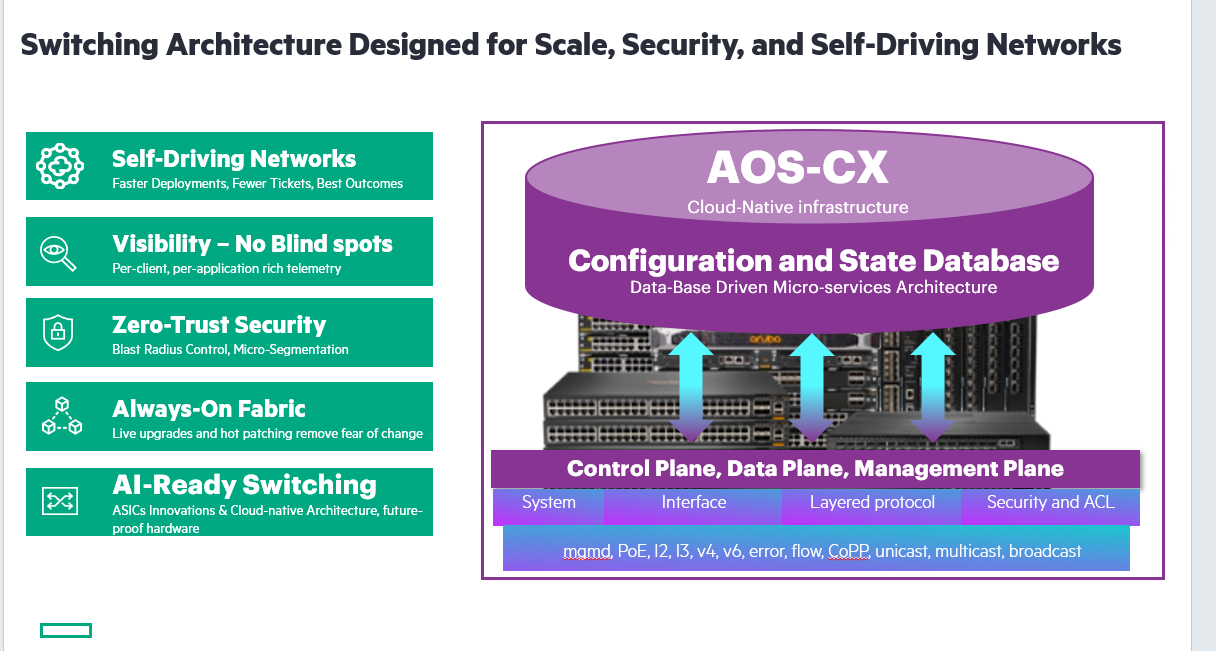
The breakthrough: database‑driven microservices architecture.
The real shift happens when configuration and state live in a real‑time database.
In this model:
- The database is the single source of truth
- All services subscribe to state changes
- Control, data, management, and security stay in sync
This isn't just cloud‑native design.
👉 It's operational architecture.
With Aruba AOS‑CX, this enables:
- Deterministic behaviour across the switch
- End‑to‑end state visibility
- Safe with confidence-thanks to architecture.
Dear team,
Database‑driven microservices are the foundation for self‑driving healthcare networks.
More details: contact me or the team.
Go, Rockstars, explain this to your customers and partners. Simple goal: help our customers to achieve safe digital transformation.
Go 2026, Go HPE!
Yash
-------------------------------------------